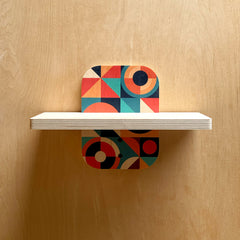
Let’s set the scene.
You found a great deal on a floating shelf online. It was $15. It looked perfect in the photos. You installed it, stepped back, and felt a surge of DIY pride. You placed your favorite potted plant on it.
And then… it happened.
The "Tilt of Shame."
Slowly, almost imperceptibly at first, the front edge of the shelf started to dip. A small gap appeared between the wood and the wall. You tightened the screws. You checked your level. But a week later, your books are sliding off like they’re on a tiny wooden slide, and you’re wondering if your wall is broken.
We have good news and bad news. The good news: Your wall is probably fine. The bad news: That shelf was doomed by physics before you even opened the box.
At WoodSnap, we don't just cut wood; we engineer it. So today, we’re going to take a break from decor tips to talk about Torque, why "invisible rods" are the enemy of stability, and why our heavy duty wall shelves are designed to defy gravity.
Part 1: Physics 101 (Or, Why Gravity Hates Your Shelf)
Most people think that if a shelf says "Rated for 20 lbs," it means you can put a 20 lb weight anywhere on it.
That is a lie.
To understand why shelves sag, you have to understand Torque.
Think of it this way: Imagine holding a 10 lb dumbbell against your chest. Pretty easy, right? Now, imagine holding that same 10 lb dumbbell with your arm fully extended straight out in front of you. Suddenly, it feels like 50 lbs. Your shoulder starts to burn. Your arm starts to shake.
That is torque. The further the weight is from the support point (your shoulder), the more force it applies.
A floating shelf is just a lever arm.
-
Weight placed at the back (near the wall) is easy for the bracket to hold.
-
Weight placed at the front edge acts like a multiplier.
When cheap manufacturers test their shelves, they often place the weight right against the wall to get a higher "rating." But in the real world, you put things on the edge of the shelf. If the bracket isn't engineered to handle that multiplier, the shelf tilts. It’s not magic; it’s math.
Part 2: The "Invisible Rod" Problem
If you’ve ever bought a budget floating shelf from a big-box store, you’ve likely seen the hardware. It’s usually a metal plate with two thin rods sticking out. You slide the shelf onto these rods.
This design looks clean, but it has a fatal flaw.
The rods are a pivot point. In cheap manufacturing, these rods are often welded poorly or are simply too thin. When you apply torque (i.e., put a book on the shelf), the rod actually bends inside the wood.
Furthermore, because the rod is "floating" inside a hole drilled into the shelf, there is often "play" or wiggle room. Gravity finds that wiggle room immediately. The moment you let go of the shelf, it settles into that gap, resulting in an instant 5-degree droop.
We hate that.
That’s why our mounting systems are designed differently. We focus on securing the shelf with hardware that locks it tight against the wall, minimizing leverage and eliminating the "wiggle" that causes sag.
Part 3: The Material Factor (Why Particle Board Surrenders)
Even if you have the strongest bracket in the world, it doesn't matter if the shelf itself turns to mush.
This is the dirty secret of the "Engineered Wood" industry. Most cheap shelves are made of Particle Board or MDF (Medium Density Fiberboard). Essentially, this is sawdust and glue pressed together.
Here is what happens when you install a particle board shelf:
-
You drive a screw or slide a bracket into the material.
-
Gravity pulls down on the shelf.
-
The metal hardware is harder than the "wood," so it starts to crush the soft inside of the shelf.
-
The screw hole gets slightly bigger. The bracket gets loose.
-
The Sag Begins.
Once particle board starts to crumble internally, there is no fixing it. You can’t tighten the screw because there is nothing left for the screw to bite into.
The WoodSnap Difference: Solid Birch Plywood This is why we are obsessed with Solid Birch Wood.
We use furniture-grade Baltic Birch plywood. This isn't the plywood you see boarding up windows; this is an architectural material used in high-end cabinetry. It is comprised of multiple layers of real hardwood, cross-banded for stability.
It is dense. It is hard. When you drive hardware into Birch, it bites. It holds. It doesn't crumble under pressure. When you mount our Corner Wall Shelves, the wood is strong enough to handle the torque without surrendering.
Part 4: What "35 lbs" Actually Looks Like
We rate our shelves conservatively because we know you actually use them. When installed into studs, many of our shelves can support 20-35 lbs.
But what does 35 lbs actually look like? It’s probably more than you think.
-
It’s 15 Hardcover Novels: Go ahead, stack them up. That’s a mini-library.
-
It’s a Large Potted Plant: We’re talking a heavy ceramic pot with wet soil and a healthy Monstera.
-
It’s a Very, Very Fat Cat: An average cat is 10 lbs. You could put three of them on there (though getting them to sit still is a different physics problem entirely).
When you buy a shelf with a high weight capacity, you aren't just buying the ability to store bricks. You are buying Peace of Mind. You are buying the knowledge that if your toddler bumps into the wall, the shelf isn't going to come crashing down.
Conclusion: Buy Nice or Buy Twice
There is an old saying in the carpentry world: "Buy nice or buy twice."
You can save $10 today on a shelf with bad physics and questionable materials. But when it starts the "Tilt of Shame" in three months, you’ll end up replacing it anyway.
We believe in building things once. We believe in using real wood that holds a screw. And we believe that the only thing that should be "floating" is the look—not the structural integrity.
Don't fight gravity. Work with it.
Ready for a shelf that stays straight? Shop our Simple & Sturdy Wall Shelves
(Need a solution for those tricky 90-degree angles? Check out our Corner Shelf Collection for the same solid wood strength, designed for corners.)